
I found out about a website today, The Fun Theory, that’s “dedicated to the thought that something as simple as fun is the easiest way to change people’s behavior for the better. Be it for yourself, for the environment, or for something entirely different, the only thing that matters is that it’s change for the better.”
What a great concept. People love to have fun. Combining that with change is awesome.
They’ve posted several videos of creative ideas on their website. Here’s one about getting people to obey the speed limit:
“Fun can change behavior for the better. We call it the fun theory.”

You know how we sometimes hear about something that happened, and say “Oh [insert name] would do something like that…”?
I don’t want to be the name inserted in that statement. I want to be unpredictable.
Unpredictable, in the sense that you don’t know what I’m capable of. I don’t want to be part of “Oh, he can’t.” I want to be part of “Oh, he can.”
I think it’s a mistake to count people out.
I don’t ever want to become labeled as a static figure, thought to be stuck in a status quo. I want to be dynamic and always changing. After all, I’m living and learning every day.
If I ever become predictable, let me know.
If everyone communicated better, the world would be a much more peaceful place.
Most times, arguments and fights are the cause of miscommunication or non-communication. If the two sides are able to communicate effectively, no conflict arises. And it doesn’t necessarily have to be communication through talking either. Sometimes, it might be better to use visuals, smells, or even taste or touch. You don’t just have one sense, you have five. Use them.
Before you start yelling at someone, try to picture what it’d be like in their shoes.
Before you give the cold shoulder and silent treatment, think about what the other person is feeling.
Taking on an empathetic mindset with regards to communication can lead to better understanding. Think about how there might be a communication gap. And if there is, solve it… with communication.
Inspiration: Man With the Golden Arm
James Harrison is a 74-year-old Australian man who has been donating his blood for 56 years.
Harrison made a pledge to be a donor at age 14 after undergoing major chest surgery in which he needed 13 liters of blood. “I was in hospital for three months,” he says. “The blood I received saved my life so I made a pledge to give blood when I was 18.”
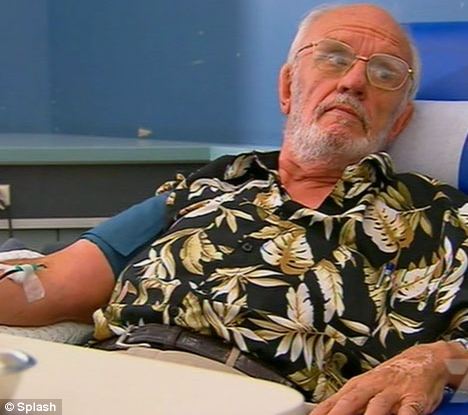
Photo by Splash News
Just after he started donating, Harrison was found to have the extremely rare kind of antibody in his blood. He became known as the “man with the golden arm.” Ever since he was 18 years old, Harrison has been giving blood every few weeks and has now racked up a total of 984 donations.
What makes him so special is his extremely rare kind of blood. His plasma has a rare and life-saving antibody that stops babies dying from Rhesus disease, a form of severe anaemia. At the time, thousands of babies in Australia were dying each year of Rhesus disease. Other newborns suffered permanent brain damage because of the condition.
After his blood type was discovered, Harrison volunteered to undergo a series of tests to help develop the Anti-D vaccine. “I wasn’t scared. I was glad to help. I had to sign every form going and basically sign my life away.”
His rare blood and plasma and the Anti-D vaccine has been given to hundreds of thousands of women, and also to babies after they are born to stop them developing Rhesus disease. It is estimated he has helped save the lives of more than two million babies so far.
“I’ve never thought about stopping. Never.”
Harrison is expected to reach the 1,000 blood donation milestone in September this year.
From interaction with peers and personal experience, a continuous 8am-3pm class schedule is dreaded by pretty much all college students. I have a super long day of classes two days of the week and it’s tough to get through them. They seem to burn me out rather easily.
But it was only a few years ago in high school when we went through 8am-3pm classes everyday. And we usually had afterschool sports and activities tacked on afterward as well.
Similarly, as a college student, I hate waking up 8am classes. Too early, I always say. But in high school, this happened daily… five days a week, and it was no big deal.
It’s kind of funny how the setting and a little time can change perspective so much.